

Request a Call




43
Years+
Combined Expertise

17,800
+
Successful IVF & ICSI Procedures

58,000
+
Happy Patients
Why Choose Us?

India's 1st stand-alone NABH Accredited IVF Centre

State of-the-ART IVF Lab

Pre Genetic Testing

Foreign Trained Doctors

Pioneer in IVF Technology

ESHRE Certified Full Time Embryologists

Advanced Technology & Infrastructure

Most Ethical and Transparent Practices

All Facilities Under One Roof

International Patient Services

Infertility Counselling

Care and Transparency

World Class Technology
Our Treatments




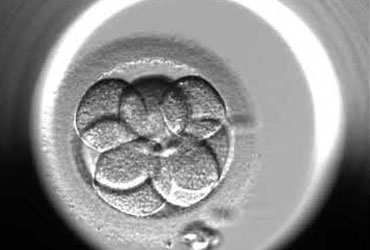
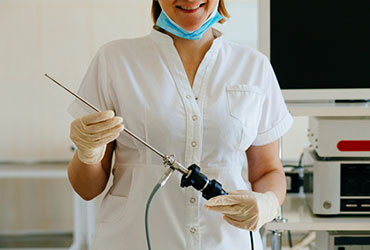
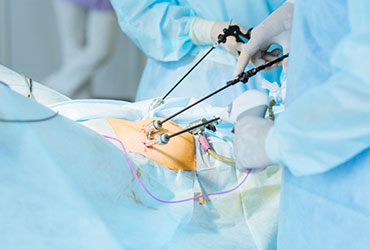


Pristyn Care Ferticity IVF & Fertility Clinics
Pristyn Care Ferticity IVF & Fertility Clinics is the best IVF and infertility treatment centre located in Malviya Nagar, South Delhi. With our world-class labs, infertility experts and most ethical practices we aim to make your dream of experiencing parenthood come true. The warm, tidy and welcoming atmosphere of our centre will make you feel right at home.
The need for personalized care and treatment for infertility management varies from a person to person, and that’s why we at Pristyn Care Ferticity IVF & Fertility Clinics focus on providing a comprehensive evaluation of couples seeking fertility treatments to provide you with the best treatment that is tailored for you. We bring the best of clinical expertise with a vast pool of experience and high-end technology for couples and help them progress from “Exception to Conception” and this is what we as the best IVF centre in South Delhi aim for.
Our reputation thrives with the strength and experience of our clinical team which provides continuity of care to the patients beginning with the first consultation that extends to the completion of the treatment cycle. Our clinical team customizes treatment protocols for the patients and performs all required diagnostic tests, ultrasounds and IVF procedures. The journey to parenthood is a partnership truly shared between the patients, doctors and the staff by providing tenderhearted care at every step of this beautiful journey. Through assisted reproductive technology like In-vitro fertilization (IVF), we have helped over 40,000+ couples around the world. We are proud to provide fertility treatments for patients around the world with the highest success rate in the field at affordable costs.
Blogs
PCOS/PMOS and Pregnancy: Can I Get Pregnant Naturally?
If you are wondering about getting pregnant naturally with PCOS, the good news is that PCOS, also called Polyendocrine Metabolic Ovarian Syndrome (PMOS), does not mean you cannot become pregnant. Many women with PCOS conceive naturally, while others may need medical support to improve ovulation. PCOS/PMOS can affect fertility mainly because it may cause […]
Read More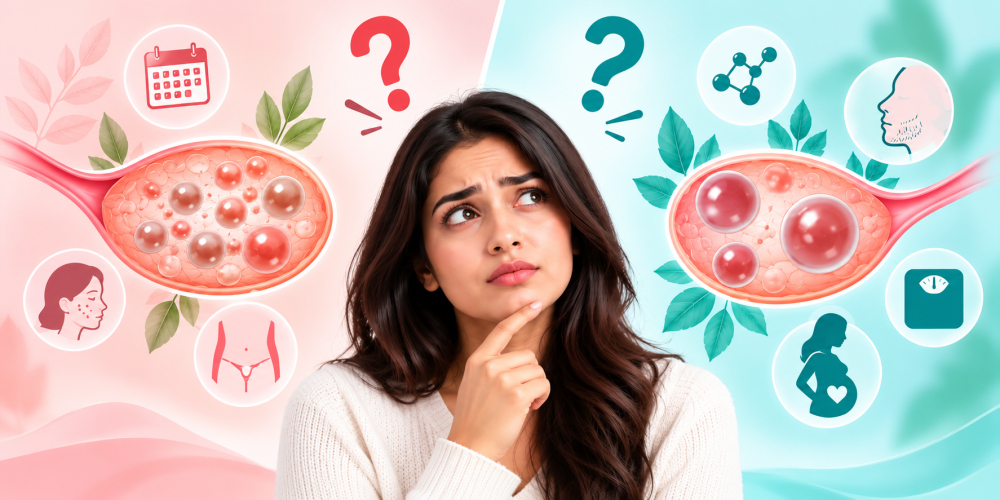
PCOD vs PCOS (PMOS): Differences, Symptoms & How they Affect Getting Pregnant
People often use PCOD and PCOS interchangeably, especially in India. However, the two terms do not simply describe the same condition. PCOS, now also called Polyendocrine Metabolic Ovarian Syndrome (PMOS), is a recognised hormonal and metabolic condition. It can affect ovulation, periods, androgen levels, metabolism and fertility. People commonly use the term PCOD (Polycystic Ovarian […]
Read More
पीसीओएस को नेचुरली कैसे कंट्रोल करें? डाइट, एक्सरसाइज और घरेलू उपाय
पीसीओएस (PCOS) क्या है? पीसीओएस (Polycystic Ovary Syndrome) महिलाओं में होने वाला एक हार्मोनल विकार (Hormonal Disorder) है। इस स्थिति में शरीर में प्रजनन हार्मोन का संतुलन बिगड़ जाता है, जिससे अंडाशय (Ovaries) सामान्य रूप से काम नहीं कर पाते। इसके कारण: पीरियड्स अनियमित हो सकते हैं। ओव्यूलेशन (Ovulation) प्रभावित हो सकता है। शरीर में […]
Read More
Semen Analysis Test: What It Measures, Normal Range & What Abnormal Results Mean
A semen analysis test, also known as a sperm analysis test, is one of the first and most important investigations used to evaluate male fertility. It examines the quality and quantity of semen and sperm to determine whether they are capable of fertilizing an egg. The test measures several key parameters, including semen volume, sperm […]
Read More
Follicular Monitoring: What It Is, How It’s Done & Why It Matters for Fertility
If you are trying to conceive, your doctor may recommend follicular monitoring to understand how your ovaries are functioning. This simple ultrasound-based test helps track the growth and development of ovarian follicles during your menstrual cycle. Follicular monitoring plays an important role in both natural conception and fertility treatments such as ovulation induction, intrauterine insemination […]
Read MoreWe are one of the best IVF center in Delhi

1.83K
Subscribers

5.67 ( 567 reviews)

4.5(280 reviews)

4.5(362 reviews)

5 Out Of 5

Need An Emergency Help?
Call Us! 9266040423
FAQ
Get Answers Of Your Every
Single Question
In Vitro (‘in glass’) Fertilization refers to a medical process of assisted reproductive technology used in the treatments of infertility and/or gestational surrogacy. In this process, an egg from a woman’s ovaries is retrieved and fertilized by sperm outside her body, in a lab. The fertilized egg is then implanted into the woman’s uterus to achieve pregnancy. This cycle of IVF usually takes up to 3 weeks.
Female infertility is an inability to conceive and have a successful pregnancy. Infertility is typically diagnosed after a woman has tried to get pregnant (through unprotected sex) for 12 months without a pregnancy. The most common causes of female infertility can be-
Age, Endometriosis, Hormonal issues leading to ovulation problems, Tubal blockage, Fibroids and
Lifestyle factors: Being overweight, smoking, drinking alcohol, unhealthy diet, Unexplained infertility.
The best way to choose an IVF doctor is by choosing the best IVF centre. The IVF centre must have a team of professional experts and skilled specialists in the field of Surgery, Gynaecology, Embryology and Geneticists who can provide you the right treatment for all your infertility related problems. Another major factor is the success rate of the centre in carrying out successful IVF procedures, which can only be ensured by experts in this field.
IVF Treatment is the best option for women who are not able to conceive naturally. The best age or the most appropriate age to achieve successful IVF procedures in women varies between their 20’s and early 30’s years of age. After reaching her mid 30’s, a woman’s success rate steadily tends to decline.
The success rate of IVF if using one’s own eggs usually begins to drop around the age of thirty and dips rapidly in the mid-30s and early 40s, due to lower egg quantity and quality. In addition to age, success rates also vary concerning one’s height, weight, infertility diagnosis, sperm count, and reproductive histories, such as the previous number of pregnancies, miscarriages and births.